Posted: 8:46 PM - Feb 19, 2012
From The Winchester Star dated Saturday 18 Feb 2012.
WINCHESTER- Wagons caked to their axles with mud and loaded with groaning, wounded men from both armies lumbered slowly over broken fields, down the unpaved Middle Road and along the Valley Pike into downtown Winchester on the cold night of March 23, 1862.
These men, injured in a day-long bitter fight at the Pritchard and Glass farms near Kernstown, were the first casualties in what would be an escalating series of bloody battles around the city over the next three years.
Among the wounded Union soldiers was Cpl. William Calvin Hileman, a 23-year-old farm boy from Frankstown, near the canal town of Hollidaysburg in central Pennsylvania.
His enlistment papers say he was 5 feet, 8 inches tall, with blond hair and blue eyes. He was the sixth of 15 children. His mother had died when he was 3 years old, and his father was remarried.
His grandfather, Michael Hileman, was a pioneer settler of the area, and a veteran of the American Revolution.
This was Hileman's first significant battle since his enlistment in the 84th Pennsylvania Volunteer Infantry in Hollidaysburg on Oct. 24, 1861 - and it was destined to be his last.
"Deeds of noble daring"
An estimated 320 soldiers were killed or mortally wounded at Kernstown, and another 700 were wounded, but survived.
According to a newspaper account published on April 2, 1862, in the Altoona (Pa.) Tribune, 11 days after the battle, Hileman's Company C went into the battle with 22 men, of whom four survived. One of the survivors was his tent mate, next-door neighbor and first cousin, William K. Hileman. (William K. Hileman, who went on to serve in 31 battles and survive the war, was destined to be my late husband's great-great grandfather.)
Hileman's hometown newspaper vowed to "record some of the deeds of noble daring performed by the boys of the 84th in this battle."
Of him, it said: "Wm. Hileman, who was seriously wounded, managed, with great pain, to get upon his side and fired seven rounds at the enemy, resting his rifle upon a rail, and each ball found its rebel victim."
The Good-Hileman genealogy, published in 1912 and, most likely based on accounts from his cousin, says Hileman was wounded by three balls: "a flesh wound in the arm, another in the leg, and the fatal wound was caused by a bullet passing through a lung."
The losses for the Pa. 84th were the heaviest of all the Union units engaged in the battle - a 36 percent casualty rate within 45 minutes of action late in the afternoon. Union troops assaulted the Confederate artillery emplacement that had been raining fire on them throughout the day, driving the defending Confederate infantry behind a breast-high stonewall into a wild retreat.
Of five companies of 255 men in the 84th, the unit lost its commanding officer, Col. William Gray Murray, one captain, one lieutenant, 23 privates and 63 wounded. Many of those listed as wounded, including Hileman, later died of their wounds.
A private's account
Xenophon Wheeler, a private with Company G, 67th Ohio, was wounded in the same assault while fighting with the 8th Ohio.
In 1908, Wheeler recalled the wagon ride off the hill at the Glass farm (which today borders Va. 37 outside Winchester) as taking the wounded soldiers "though fields, lately forests, where stumps and rocks abounded. It was very painful, but not different from what tens of thousands of others experienced."
Hileman and many of the other Union wounded were taken to the Union Hotel hospital, and, those who survived 10 days were transferred to the York Hospital (later the Fairfax Seminary) on what was then Market Street (now Cameron Street).
The Union Hotel hospital has been torn down, but was near the site of the F.L. Glaize Building at 302 N. Cameron. The York Hospital building, which survives, is now the law offices of McKee and Butler at 112 S. Cameron.
"The wounded fared pretty badly for a few days after the battle of Winchester, or Kearnstown [sic], for it was before the days of State and Sanitary Commission," Wheeler said. "Our beds were blankets laid on the ground. Meals were very uncertain and illy adapted to the appetites of wounded and sick men."
A Union nurse, Harriet Dada, who arrived in Winchester after the battle, wrote in her memoirs that "we found everything very much unsettled in the Union Hotel hospital. Nothing was ready for the comfort of the wounded .... On Monday, after the battle, 37 had died in this hospital. For days they laid on the floor. The Confederate women brought in things for their wounded, but passed ours by, till the surgeon told them they should not enter the hospital if they continued doing so. The Union people, both white and colored, daily brought food from them own homes and distributed them to all alike."
"Kind ladies"
Little more is known of Hileman's final days. If a photograph was ever taken of him, it has not survived.
When he died on March 29, 1862, six days after the battle, his body was taken by train to Hollidaysburg, where he was buried on April 3 with military honors in the Presbyterian Cemetery.
One tantalizing clue to his last days and hours, however, has come down in the family genealogy.
"While in the hospital, he was waited upon by the kind ladies of Winchester," the record states. "Being so weak, he was fed by a young lady, Anna Jackson, said have been a relative of Stonewall Jackson. When his body was brought home, among his possessions was this lady's picture, which she had given to him."
In researching Anna Jackson, I soon concluded, with the aid of local historian Ben Ritter, that any connection with Stonewall Jackson's wife was highly unlikely.
Jackson's wife Anna had indeed spent the winter in Winchester, but had evacuated when the Confederates fled the city on March 11 before the advance of Union troops.
There was, however, another Ann Jackson in town, and she was almost certainly the woman who nursed the young soldier.
A Quaker and a Unionist
One of the most prominent Union sympathizers in Winchester during the war was Joseph Steere Jackson.
He was 52 at the time of the 1860 Census, and lived with his wife Mary and five children, ages 13 to 22, at 35 W. Piccadilly St. in a stone house that still stands.
Jackson was a hat manufacturer who had a retail business at 135 N. Loudoun St., where he made "beaver, felt, straw and silk hats, as well as fur and cloth caps," according to "What I Know About Winchester," by William Russell Greenway. The Civil War forced the closure of his business.
Jackson was a Quaker, and he and about 20 other Unionist men were taken prisoner by Jackson when he withdrew from the city on March 11, 1862. The men were forced into a prison camp near Staunton because they were suspected by the Confederates of being Union spies.
Nurse Harriet Dada notes that she stayed at the Jacksons' house on the night she arrived in Winchester, shortly after the battle at Kernstown.
Jackson's oldest daughter, known as Annie, was 22 at the time, and was known to be "a strong Union girl," according to the "Hopewell Friends History, 1734-1934," written by John Walter Wayland.
According to her obituary, published on Oct. 16, 1925 in the Winchester Star, Annie (Jackson) Rees was "one of the belles of the ante-bellum period and the ambrotype photographs of her taken at this period show her as a most beautiful young girl."
"During the Civil War," the obituary continues, " Mrs. Rees was a volunteer nurse at York Hospital on South Market street, later on to be Fairfax Seminary for young girls. Here she nursed the wounded soldiers of both armies gathered from the battlefields in and around Winchester."
This ambrotype was likely the image of her that young Hileman had on him when his body was taken home and that so intrigued his family to mention it 50 years later when the genealogy was written.
A well-traveled flag
The Friends' history relates another interesting story involving Ann Jackson and her devotion to the Union cause.
When Union troops fled Winchester on June 15, 1863, during the Second Battle of Winchester, Union Gen. Robert H. Milroy left behind a Union flag with 34 stars that was flying over Fort Milroy (also known as Fort Garibaldi) in northwest Winchester.
The Confederates took down the flag and stored it carefully in a box, in preparation for shipment to Richmond, where Jefferson Davis was collecting captured Union flags.
Mary Joy, a young girl working in the home of Joseph Jackson, had recently married a Union soldier. She feared her husband might be among the Union forces captured and brought back to the fort.
She headed up the hill with a basket of provisions and found him there. Her husband and another soldier, who had found the flag that had been tucked away for safekeeping, "bound it around her as a petticoat and told her to take it to Annie Jackson," according to the Quaker history. "Annie Jackson was chatting with some Confederate soldiers, but May called her out of the room and soon transferred to her the flag she had brought."
"Then began days of rapid movings of the celebrated flag," the account states. "Both parties wanted it. The Jacksons were suspected by the Confederates, and one searching squad after another came to the house. The flag was taken from one hiding place to another - in ash barrels, under mattresses, in dark corners of the cellar, under the eaves of the roof - and it was not found."
In 1864, Annie Jackson married Jonah L. Rees and moved to Canton, Ohio, with him, taking the flag with her. After keeping it for 62 years, she sent it to Gen. Joseph W. Keifer of Springfield, Ohio, whom she had known during the war when he commanded the Ohio volunteer infantry units in Winchester.
Charm and gentleness
The flag, which flew over Winchester during Milroy's occupation, is now in the collection of the Ohio Historical Society in Columbus.
In a speech to the society when he donated the flag, Keifer told the story of its capture and recapture, and confirmed that it was sent to him on Jan. 7, 1922, by Annie Jackson Rees of Winchester, where she was living.
Ann and Jonah Rees returned to Winchester later in life to take over her father's farm north of the city on Martinsburg Pike (U.S. 11).
"She was one of the grand old ladies of the community," her obituary states. "Eighty-eight years of age, she was always cheerful and smiling; she had a good word for everybody; gossip or idle talk never passed her lips. She was perhaps not wise in the ways of the modern world, but her gentleness and simplicity were of the past regime, and it lent charm to an already sweet disposition."
The same charm and gentleness, no doubt, that won the heart of a Pennsylvania farm boy as he lay on his deathbed 63 years earlier.
- Contact Maria Hileman at mhileman@winchesterstar.com
By maria hileman
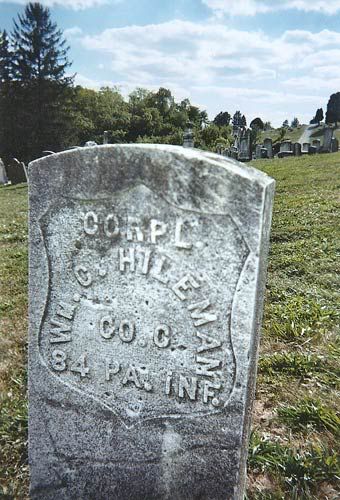 The grave of Cpl. William C. Hileman in the Presbyterian Cemetery in Hollidaysburg, Pa. Hileman was a soldier in the 84th Pennsylvania Infantry who was mortally wounded at the First Battle of Kernstown and died in Winchester six days later. It was his first major battle, and his last (Photo by Photo provided by Donald B. Crider) |
These men, injured in a day-long bitter fight at the Pritchard and Glass farms near Kernstown, were the first casualties in what would be an escalating series of bloody battles around the city over the next three years.
Among the wounded Union soldiers was Cpl. William Calvin Hileman, a 23-year-old farm boy from Frankstown, near the canal town of Hollidaysburg in central Pennsylvania.
His enlistment papers say he was 5 feet, 8 inches tall, with blond hair and blue eyes. He was the sixth of 15 children. His mother had died when he was 3 years old, and his father was remarried.
His grandfather, Michael Hileman, was a pioneer settler of the area, and a veteran of the American Revolution.
This was Hileman's first significant battle since his enlistment in the 84th Pennsylvania Volunteer Infantry in Hollidaysburg on Oct. 24, 1861 - and it was destined to be his last.
"Deeds of noble daring"
An estimated 320 soldiers were killed or mortally wounded at Kernstown, and another 700 were wounded, but survived.
According to a newspaper account published on April 2, 1862, in the Altoona (Pa.) Tribune, 11 days after the battle, Hileman's Company C went into the battle with 22 men, of whom four survived. One of the survivors was his tent mate, next-door neighbor and first cousin, William K. Hileman. (William K. Hileman, who went on to serve in 31 battles and survive the war, was destined to be my late husband's great-great grandfather.)
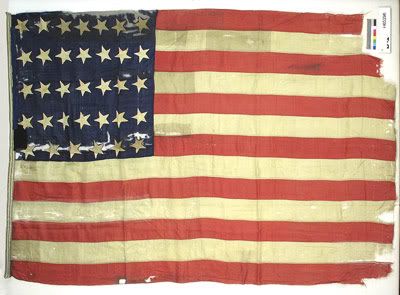 This Union flag with 34 stars flew over Fort Milroy in northwest Winchester in 1863. It was left flying when Union troops evacuated the city. Women loyal to the Union, including Annie Jackson, stole the flag and hid it from Confedereate soldiers. Annie (Jackson) Rees held onto it for 62 years after the Civil War. It's now in the collection of the Ohio Historical Society in Columbus. (Photo by /Photo provided by the Ohio Historical Society) |
Of him, it said: "Wm. Hileman, who was seriously wounded, managed, with great pain, to get upon his side and fired seven rounds at the enemy, resting his rifle upon a rail, and each ball found its rebel victim."
The Good-Hileman genealogy, published in 1912 and, most likely based on accounts from his cousin, says Hileman was wounded by three balls: "a flesh wound in the arm, another in the leg, and the fatal wound was caused by a bullet passing through a lung."
The losses for the Pa. 84th were the heaviest of all the Union units engaged in the battle - a 36 percent casualty rate within 45 minutes of action late in the afternoon. Union troops assaulted the Confederate artillery emplacement that had been raining fire on them throughout the day, driving the defending Confederate infantry behind a breast-high stonewall into a wild retreat.
Of five companies of 255 men in the 84th, the unit lost its commanding officer, Col. William Gray Murray, one captain, one lieutenant, 23 privates and 63 wounded. Many of those listed as wounded, including Hileman, later died of their wounds.
A private's account
 Scott Mason/The Winchester Star |
In 1908, Wheeler recalled the wagon ride off the hill at the Glass farm (which today borders Va. 37 outside Winchester) as taking the wounded soldiers "though fields, lately forests, where stumps and rocks abounded. It was very painful, but not different from what tens of thousands of others experienced."
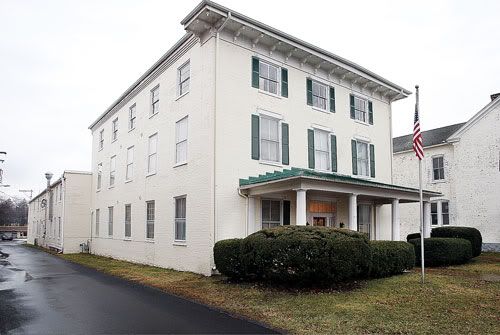
Hileman and many of the other Union wounded were taken to the Union Hotel hospital, and, those who survived 10 days were transferred to the York Hospital (later the Fairfax Seminary) on what was then Market Street (now Cameron Street).
The Union Hotel hospital has been torn down, but was near the site of the F.L. Glaize Building at 302 N. Cameron. The York Hospital building, which survives, is now the law offices of McKee and Butler at 112 S. Cameron.
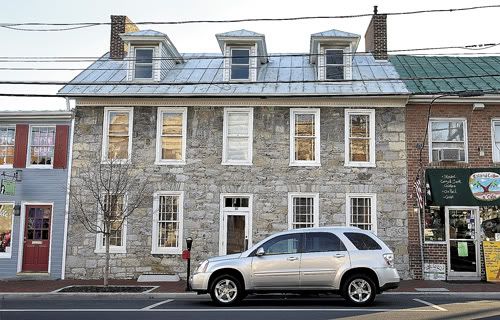 This home at 35 W. Piccadilly St., was the home of Joseph S. Jackson, a Quaker hatmaker who was a staunch Unionist. His eldest daughter, Annie Jackson, nursed Union and Confederate soldiers. (Photo by Ginger Perry/The Winchester Star) |
A Union nurse, Harriet Dada, who arrived in Winchester after the battle, wrote in her memoirs that "we found everything very much unsettled in the Union Hotel hospital. Nothing was ready for the comfort of the wounded .... On Monday, after the battle, 37 had died in this hospital. For days they laid on the floor. The Confederate women brought in things for their wounded, but passed ours by, till the surgeon told them they should not enter the hospital if they continued doing so. The Union people, both white and colored, daily brought food from them own homes and distributed them to all alike."
"Kind ladies"
Little more is known of Hileman's final days. If a photograph was ever taken of him, it has not survived.
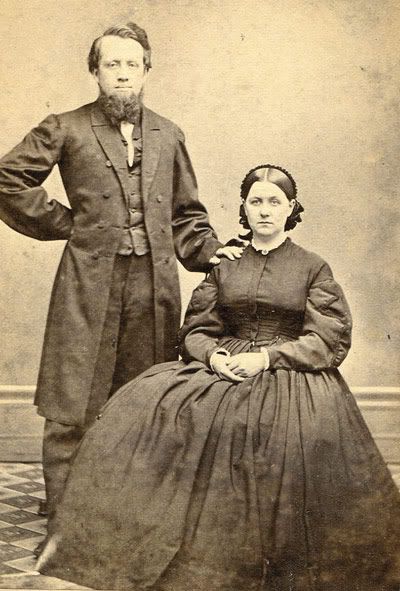 In 1864, Annie Jackson married Jonah L. Rees and moved with him to Canton, Ohio. |
One tantalizing clue to his last days and hours, however, has come down in the family genealogy.
"While in the hospital, he was waited upon by the kind ladies of Winchester," the record states. "Being so weak, he was fed by a young lady, Anna Jackson, said have been a relative of Stonewall Jackson. When his body was brought home, among his possessions was this lady's picture, which she had given to him."
In researching Anna Jackson, I soon concluded, with the aid of local historian Ben Ritter, that any connection with Stonewall Jackson's wife was highly unlikely.
Jackson's wife Anna had indeed spent the winter in Winchester, but had evacuated when the Confederates fled the city on March 11 before the advance of Union troops.
There was, however, another Ann Jackson in town, and she was almost certainly the woman who nursed the young soldier.
A Quaker and a Unionist
One of the most prominent Union sympathizers in Winchester during the war was Joseph Steere Jackson.
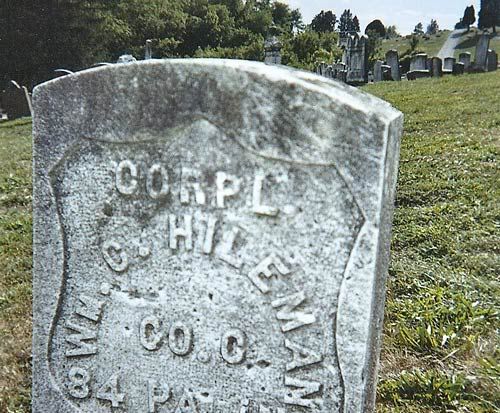 The grave of Cpl. William C. Hileman in the Presbyterian Cemetery in Hollidaysburg, Pa. Hileman was a soldier in the 84th Pennsylvania Infantry who was mortally wounded at the First Battle of Kernstown and died in Winchester six days later. It was his first major battle, and his last. (Photo by /Photo provided by Donald B. Crider) |
Jackson was a hat manufacturer who had a retail business at 135 N. Loudoun St., where he made "beaver, felt, straw and silk hats, as well as fur and cloth caps," according to "What I Know About Winchester," by William Russell Greenway. The Civil War forced the closure of his business.
Jackson was a Quaker, and he and about 20 other Unionist men were taken prisoner by Jackson when he withdrew from the city on March 11, 1862. The men were forced into a prison camp near Staunton because they were suspected by the Confederates of being Union spies.
Nurse Harriet Dada notes that she stayed at the Jacksons' house on the night she arrived in Winchester, shortly after the battle at Kernstown.
Jackson's oldest daughter, known as Annie, was 22 at the time, and was known to be "a strong Union girl," according to the "Hopewell Friends History, 1734-1934," written by John Walter Wayland.
According to her obituary, published on Oct. 16, 1925 in the Winchester Star, Annie (Jackson) Rees was "one of the belles of the ante-bellum period and the ambrotype photographs of her taken at this period show her as a most beautiful young girl."
"During the Civil War," the obituary continues, " Mrs. Rees was a volunteer nurse at York Hospital on South Market street, later on to be Fairfax Seminary for young girls. Here she nursed the wounded soldiers of both armies gathered from the battlefields in and around Winchester."
This ambrotype was likely the image of her that young Hileman had on him when his body was taken home and that so intrigued his family to mention it 50 years later when the genealogy was written.
A well-traveled flag
The Friends' history relates another interesting story involving Ann Jackson and her devotion to the Union cause.
When Union troops fled Winchester on June 15, 1863, during the Second Battle of Winchester, Union Gen. Robert H. Milroy left behind a Union flag with 34 stars that was flying over Fort Milroy (also known as Fort Garibaldi) in northwest Winchester.
The Confederates took down the flag and stored it carefully in a box, in preparation for shipment to Richmond, where Jefferson Davis was collecting captured Union flags.
Mary Joy, a young girl working in the home of Joseph Jackson, had recently married a Union soldier. She feared her husband might be among the Union forces captured and brought back to the fort.
She headed up the hill with a basket of provisions and found him there. Her husband and another soldier, who had found the flag that had been tucked away for safekeeping, "bound it around her as a petticoat and told her to take it to Annie Jackson," according to the Quaker history. "Annie Jackson was chatting with some Confederate soldiers, but May called her out of the room and soon transferred to her the flag she had brought."
"Then began days of rapid movings of the celebrated flag," the account states. "Both parties wanted it. The Jacksons were suspected by the Confederates, and one searching squad after another came to the house. The flag was taken from one hiding place to another - in ash barrels, under mattresses, in dark corners of the cellar, under the eaves of the roof - and it was not found."
In 1864, Annie Jackson married Jonah L. Rees and moved to Canton, Ohio, with him, taking the flag with her. After keeping it for 62 years, she sent it to Gen. Joseph W. Keifer of Springfield, Ohio, whom she had known during the war when he commanded the Ohio volunteer infantry units in Winchester.
Charm and gentleness
The flag, which flew over Winchester during Milroy's occupation, is now in the collection of the Ohio Historical Society in Columbus.
In a speech to the society when he donated the flag, Keifer told the story of its capture and recapture, and confirmed that it was sent to him on Jan. 7, 1922, by Annie Jackson Rees of Winchester, where she was living.
Ann and Jonah Rees returned to Winchester later in life to take over her father's farm north of the city on Martinsburg Pike (U.S. 11).
"She was one of the grand old ladies of the community," her obituary states. "Eighty-eight years of age, she was always cheerful and smiling; she had a good word for everybody; gossip or idle talk never passed her lips. She was perhaps not wise in the ways of the modern world, but her gentleness and simplicity were of the past regime, and it lent charm to an already sweet disposition."
The same charm and gentleness, no doubt, that won the heart of a Pennsylvania farm boy as he lay on his deathbed 63 years earlier.
- Contact Maria Hileman at mhileman@winchesterstar.com