Posted: 2:51 AM - May 18, 2009
From The Winchester Star dated Friday 15 May 2009.
Clear Brook -- As his church marks its 275th anniversary with an open house Saturday, Jim Riley says there's much more to celebrate than simply the long history of the Hopewell Meeting House.
Yes, the Winchester resident says, it's noteworthy that Hopewell has been home to worship services without interruption since its founding in 1734, making it the oldest place of worship in Frederick County.
But to Riley, it's the spiritual aspect of Hopewell that looms largest.
"There's a great cloud of witnesses here," said Riley, 63, part of the eighth generation of his family to worship at Hopewell.
Saturday's open house -- set for 1 to 5 p.m. at 604 Hopewell Road, a mile west of Clear Brook off U.S. 11 -- will offer visitors the opportunity to learn more about the church's rich history and as well as insight into what the Quaker faith stands for, Riley said.
"Sometimes you'll hear from people who have the impression that Quakerism is something that's in the past," he said. "The 275th anniversary is a chance for us to talk about what Quakers have done in the world, about what our faith is all about."
About 100,000 Quakers make their homes in the United States and Canada, according to the Web site http://www.Quakerfinder.org another 200,000 live in Europe, Africa, Asia, and elsewhere in the world.
The faith, also called the Religious Society of Friends, is widely known for a commitment to peace, Riley said.
"Quakers traditionally have worked very hard to create peace in the world," he said. "That's probably the strongest testimony of Quakers."
The church's practice of worshipping largely in silence also sets Quakers apart, Riley said.
"We don't have a minister or a priest who is seen as the leader of our worship service," he said. "We gather and sit in silence and if the spirit moves someone to speak, then that person speaks."
The denomination dates to the mid-1600s when an Englishman named George Fox began to preach of the need to turn away from the hierarchy of established churches. His radical belief: Each person could work to encounter God directly.
"That's still what we believe, that God speaks to each of us," Riley said.
Photographs of Quakers from earlier generations show them in plain dress, but Riley said that tradition has fallen away.
As for the church building itself, Hopewell remains as he remembers it from his childhood.
"We've done a few improvements on the outside, adding a handicapped ramp and a railing to the porch, but inside where our worship is held, its been pretty much the same for 250 years."
According to the church's history, the first meeting house was made of logs. After more than 20 years of use, the building was destroyed by fire in 1757. The eastern side of the current meeting house was constructed between 1759 and 1761, with another section added in 1794.
Hopewell is not only on the National Register of Historic Places, but is also designated as a Virginia Historic Landmark and a Frederick County Historic Site.
In 1999, Hopewell merged in with Centre Meeting in downtown Winchester to form the congregation now known as the Hopewell Centre Meeting.
Hopewell typically has celebrated its roots with an open house and other special events only every quarter-century or so, Riley said.
Hopewell's next big event is a homecoming celebration slated for late August.
Riley's affiliation with Hopewell has been lifelong. His mother's ancestors were among the handful of Pennsylvania families who founded Hopewell 275 years ago.
Virginia Lupton Riley was the oldest member of Hopewell when she died this month at 96.
"I'm kind of the exception, having grown up here," Riley said. "Most of the people who come to worship at Hopewell today didn't grow up with the faith. Something about Quakerism speaks to them and they attend a service and realize it's for them.
"We try to be very welcoming to anyone who comes. We want everyone to feel at home."
Saturday's tour will include the meeting house and grounds, along with the adjoining graveyard.
The church's regular worship services are scheduled for 10 a.m. Sundays.
http://hopecentre.quaker.org
Open house is scheduled for Saturday afternoon
By Christine Miller Ford
The Winchester Star
By Christine Miller Ford
The Winchester Star
Clear Brook -- As his church marks its 275th anniversary with an open house Saturday, Jim Riley says there's much more to celebrate than simply the long history of the Hopewell Meeting House.
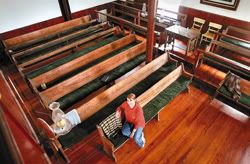 |
Mary Robare of Frederick County sits in a pew at the Hopewell Friends Meeting House in Clear Brook. The faith, also called the Religious Society of Friends, is widely known for a commitment to peace. (Photo by Jeff Taylor) |
But to Riley, it's the spiritual aspect of Hopewell that looms largest.
"There's a great cloud of witnesses here," said Riley, 63, part of the eighth generation of his family to worship at Hopewell.
Saturday's open house -- set for 1 to 5 p.m. at 604 Hopewell Road, a mile west of Clear Brook off U.S. 11 -- will offer visitors the opportunity to learn more about the church's rich history and as well as insight into what the Quaker faith stands for, Riley said.
"Sometimes you'll hear from people who have the impression that Quakerism is something that's in the past," he said. "The 275th anniversary is a chance for us to talk about what Quakers have done in the world, about what our faith is all about."
About 100,000 Quakers make their homes in the United States and Canada, according to the Web site http://www.Quakerfinder.org another 200,000 live in Europe, Africa, Asia, and elsewhere in the world.
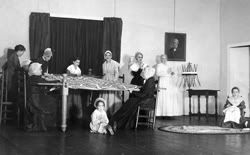 |
Quakers quilt inside the Hopewell Friends Meeting House in Clear Brook in this undated photo. |
"Quakers traditionally have worked very hard to create peace in the world," he said. "That's probably the strongest testimony of Quakers."
The church's practice of worshipping largely in silence also sets Quakers apart, Riley said.
"We don't have a minister or a priest who is seen as the leader of our worship service," he said. "We gather and sit in silence and if the spirit moves someone to speak, then that person speaks."
The denomination dates to the mid-1600s when an Englishman named George Fox began to preach of the need to turn away from the hierarchy of established churches. His radical belief: Each person could work to encounter God directly.
"That's still what we believe, that God speaks to each of us," Riley said.
Photographs of Quakers from earlier generations show them in plain dress, but Riley said that tradition has fallen away.
As for the church building itself, Hopewell remains as he remembers it from his childhood.
 |
The Hopewell Friends Meeting House is at 604 Hopewell Road, a mile west of Clear Brook off U.S. 11. (Photo by Jeff Taylor) |
According to the church's history, the first meeting house was made of logs. After more than 20 years of use, the building was destroyed by fire in 1757. The eastern side of the current meeting house was constructed between 1759 and 1761, with another section added in 1794.
Hopewell is not only on the National Register of Historic Places, but is also designated as a Virginia Historic Landmark and a Frederick County Historic Site.
In 1999, Hopewell merged in with Centre Meeting in downtown Winchester to form the congregation now known as the Hopewell Centre Meeting.
Hopewell typically has celebrated its roots with an open house and other special events only every quarter-century or so, Riley said.
Hopewell's next big event is a homecoming celebration slated for late August.
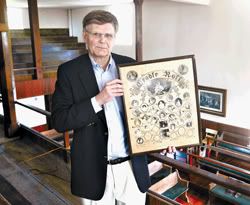 |
Jim Riley holds a cradle roll from the early 1900s that shows the young children of the Hopewell Meeting House. His mother Virginia Lupton, born in 1912, is one of the children pictured. (Photo by Rick Foster) |
Virginia Lupton Riley was the oldest member of Hopewell when she died this month at 96.
"I'm kind of the exception, having grown up here," Riley said. "Most of the people who come to worship at Hopewell today didn't grow up with the faith. Something about Quakerism speaks to them and they attend a service and realize it's for them.
"We try to be very welcoming to anyone who comes. We want everyone to feel at home."
Saturday's tour will include the meeting house and grounds, along with the adjoining graveyard.
The church's regular worship services are scheduled for 10 a.m. Sundays.
http://hopecentre.quaker.org
-- Contact Christine Miller Ford at cford@winchesterstar.com